
Is Spotify’s New Logo the Beginning of the End for Minimalism?
18/05/2026
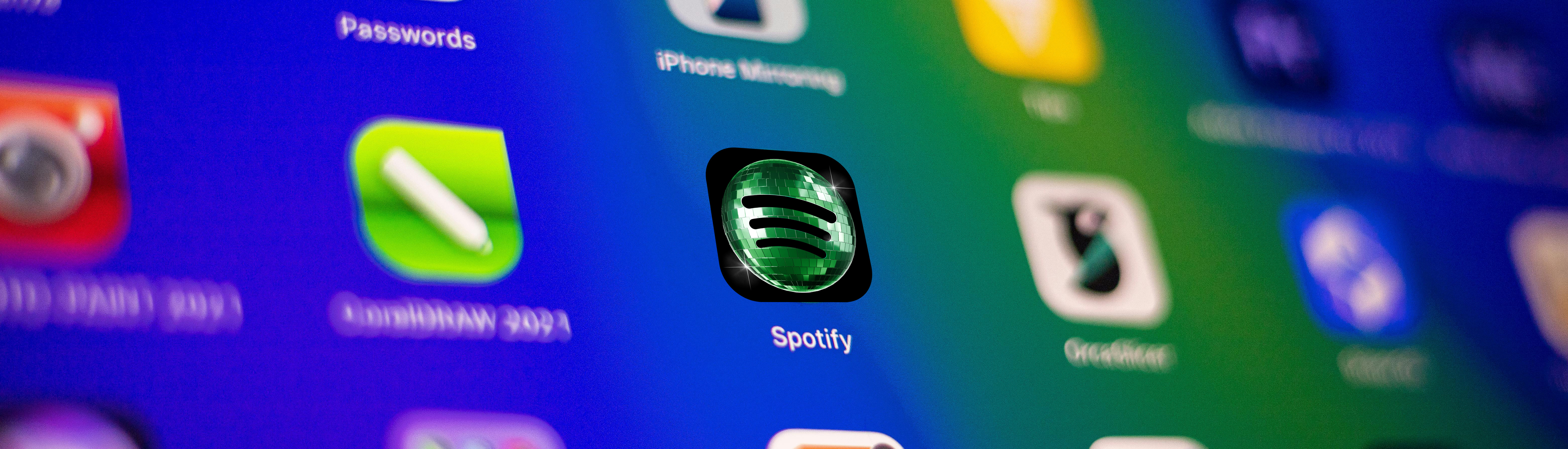
For a company whose usual branding philosophy has historically been sleek and stylish, Spotify’s latest logo change has surprised everyone. The streaming giant has replaced its iconic green circle with a shiny disco-ball-inspired version and the internet immediately lost its mind.
Opinions are divided, some people think it’s fun, nostalgic, and refreshing. Others think it looks dated, tacky, or like an old nightclub flyer from 2006. Which, arguably, is exactly why people are paying attention to it.
Is It Permanent?
Shortly after the initial uproar, Spotify confirmed the disco-ball logo is only temporary. The redesign is part of the company’s 20th anniversary celebrations and once the campaign ends, the classic green logo will return.
Temporary or not however, many people see Spotify’s willingness to swap its famously minimalist identity for something this nostalgic, and unapologetically flashy as culturally significant. For a brand so closely associated with clean, modern tech design, even a short-term move away from minimalism feels surprisingly bold.
Why Are Opinions So Divided?
One side sees the logo as playful and full of personality, a rare example of a tech company allowing itself to look slightly unserious. In an era where most platforms obsess over sleekness and optimisation, there’s something refreshing about Spotify embracing glitter and nostalgia.
The other side absolutely hates it, with critics describing it as dated, gimmicky, “cheap-looking” and aggressively Y2K. Some designers are also arguing the logo loses the simplicity and instant recognisability that make Spotify’s branding so effective. Others think it clashes with the modern UI aesthetic Spotify has spent years refining, and to be fair, they’re not entirely wrong.
The disco-ball treatment leans heavily into retro aesthetics, maximalism, and trend-driven visuals. It’s not trying to look elegant, it’s trying to feel celebratory. Whether that works probably depends on how bored you are by modern tech branding.
Is This The Beginning Of The End For Minimalism?
Perhaps that’s a tad dramatic, but the timing of this redesign is interesting. For more than a decade, major brands have steadily flattened, simplified, and sanitised their identities. We wrote an article previously about how early 2000s branding embraced Skeuomorphism, a design style where logos and interfaces mimicked real-world objects, and how flat design eventually took over. Since then, logos have become increasingly geometric, typography has shifted almost entirely to sans-serif fonts, and colour palettes have softened. Everything became cleaner, more scalable, and optimised for apps and digital platforms.
The downside of this however and a key criticism of modern branding, isn’t necessarily that minimalist logos are bad, it’s that so many brands now feel interchangeable. Airlines look like fintech startups, and fashion houses look like consulting firms. So, Spotify temporarily abandoning that approach is notable because it signals a growing willingness for big brands to experiment again.
Maybe Brands Should Be Taking More Risks
The most interesting part of the reaction isn’t whether people think the logo is ugly, it’s that people are talking about it at all. Most rebrands today pass through the internet with barely any emotional response because they feel so safe. Companies have optimised themselves to the point of visual neutrality, so nothing offends anyone, but nothing really stands out either.
Spotify’s disco-ball logo may not be universally loved, but it has personality, something many modern tech brands arguably lost years ago. It's experimental, and slightly ridiculous, which is also what makes it memorable.
Honestly, if a billion-dollar company can occasionally swap corporate minimalism for something a little louder and more playful, maybe that’s not a bad thing. Even if half the internet thinks it looks like a karaoke app from 2004.